Cross posted from Border Jumpers.
Uganda, like most of the countries in Africa, is full of contradictions.
While everyone we met in Uganda was friendly and helpful, going out of their way to assist us when we needed directions, a Wifi hotspot, or a place to find vegetarian food, the country also has some of the most restrictive laws against human rights on the continent. While we were there, the “Bahati Bill” was introduced in parliament. The Bahati called for life in prison — and in some case the death penalty — for people found “guilty” of homosexual activity.
As gay marriage laws are passed around the world, including most recently in Mexico City, it’s hard to believe that lawmakers would punish people for being gay or having HIV/AIDS. The Bahati bill also punishes anyone who fails to report a homosexual act committed by others with up to three years in jail, and a prison sentence of up to seven years for anyone who defends the rights of gays and lesbians.
Uganda’s President Yoweri Museveni, due to mounting pressure from governments such as the United States, across Europe, and in Canada, said that he opposes the measure, and would attempt to try and soften the bill. According to a recent story in Reuters, “the president has been quoted in local media saying homosexuality is a Western import, joining continental religious leaders who believe it is un-African.” With a national election looming in 2012, politicians seem to be using hatred against gays as a scapegoat for rising corruption and the weakening of civil liberties and freedom of the press.
Yet, even the possibility that a watered-down version of the proposed law could be passed, is an alarming sign of a dangerous trend of prejudice all over Africa. In Blantyre, Malawi, for example, a gay couple was arrested last week after having a traditional engagement ceremony. Homosexuality is punishable by 14 years in jail in Malawi
However, human rights advocates continue to fight. In Latin America, they hope that the success of legalized marriage in Mexico City will spread to Argentina, Venezuela, Chile, and other places. Uruguay permits gay parents to adopt and Columbia grants social security rights to same sex couples.
In the United States, gay, lesbian, bi-sexual, and transgender rights is one of the most import civil and human rights battles we currently face. Despite recent setbacks in California, New York, and Maine — recent success in places like Iowa, DC, and New Hampshire — means that during next decade the battlefield for LGBT rights is not only in Africa but also right here at home.
 Stacia and Kristof Nordin have an unusual backyard. Rather than the typical bare dirt patch of land that most Malawians sweep “clean” every day, the Nordins have over 200 varieties of mostly indigenous vegetables growing organically around their house. They came to Malawi in the 1990s as Peace Corps Volunteers, but now call Malawi home. Stacia works for the Malawi Health Ministry, educating both policy-makers and citizens about the importance of indigenous vegetables and permaculture for improving livelihoods and nutrition.
 Leonard Birahira has been connected to Heifer International in Gicumbi District for the last seven years, but only recently as a beneficiary of their projects. He’s been using his carpentry skills to help build stalls for farmers to keep their animals, a requirement for all Heifer beneficiaries, and just last month received his own dairy cow as part of Heifer’s projects in Rwanda. Dr. Dennis Karamuzi, the Director of Programs for Heifer Rwanda, told me that he’s looking forward to seeing this family in two years. Right now they live in a mud house, without electricity or running water, things the other Heifer beneficiaries we visited were able to get after they began raising cows and selling milk.
 Holindintwali Cyprien is a 40-year old farmer and livestock keeper in Gicumbi District, outside of Kigali in Rwanda. But he hasn’t always been a farmer. After the genocide in the 1990s, he and his wife, Mukaremera Donatilla, 40, were school teachers, making a about $USD 50.00 monthly. Living in a small house constructed of mud, without electricity or running water, they were saving to buy a cow to help increase their income. And when
 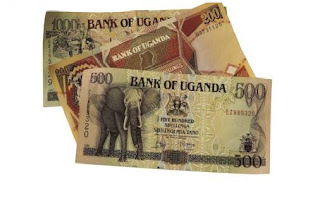 Ready for a math nightmare — every US Dollar is 1,800 Ugandan Shillings! Here’s a test for you: if something costs 51,450 shillings — what is that in US dollars? (No cheating with a calculator…)
 We also tried the local beer — called Club — which reminded me of Budweiser (no offense to to Dani’s home state of Missouri).They have a darker local beer aptly called “Nile” which we will try before leaving. Oh, and for some reason Smirnoff is not only the vodka of choice — but those little Smirnoff Ice wine coolers are ubiquitous in local hands…
 I can’t complain about the toilets (mostly clean, toilet seats almost everywhere in Kampala, but almost nowhere outside the city) — mostly because Uganda offered me my first hot shower since landing in Ethiopia!