Fierces on the Weather Critter Comment are obligatory welcome.
The morning check-in is an open thread posted to give you a place to visit with the meeses. Feel free to chat about your weather, share a bit of your life, grump (if you must), rave (if you can). The diarist du jour sometimes posts and runs, other times sticks around for a bit, often returns throughout the day and always cares that meeses are happy … or at least contented.
On weekends (and holidays), you may find the check-in thread earlier or later than normal because … it is the weekend! Moosies need their beauty rest:
For those new to the Moose, Kysen left a Moose Welcome Mat (Part Deux) so, please, wipe your feet before you walk in the front door start posting.
The important stuff to get you started:
– Comments do not Auto-refresh. Click the refresh/reload on your tab to see new ones. Only click Post once for comments. When a diary’s comment threads grow, the page takes longer to refresh and the comment may not display right away.
– To check for replies to your comments, click the “My Comments” link in the right-hand column (or go to “My Moose”). Comments will be listed and a link to Recent Replies will be shown. (Note: Tending comments builds community)
– Ratings: Fierce means Thumbs Up, Fail means Thumbs Down, Meh means one of three things: I am unFailing you but I can’t Fierce you, I am unFiercing after a mistaken Fierce, or Meh. Just Meh. (p.s. Ratings don’t bestow mojo, online behaviour does).
– The Recommended list has a prominent place on the Front Page because it reflects the interests of the Moose. When people drive-by, we want them to see what we are talking about: news, politics, science, history, personal stories, culture. The list is based on number of recs and days on the list. Per Kysen: “The best way to control Rec List content is to ONLY rec diaries you WANT to see ON the list.”
– Finally, the posting rules for a new diary: “Be excellent to each other… or else”
(Some other commenting/posting/tending notes for newbies can be found in this past check-in and, of course, consult Meese Mehta for all your questions on meesely decorum.)
A profile of a commercial photographer … whose capturing of the end of the steam train era in the 1950’s made him an icon (and not just to rail buffs) after the jump ….
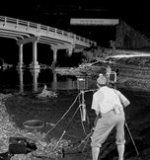
Though he trained as a civil engineer, and made a living as a publicity/advertising photographer: people today know O. Winston Link as someone who captured (principally in nighttime, black-and-white photography) the end of the steam engine era. That it was not done on a commercial assignment – but instead as a labor-of-love – led many rail buffs to look at him as the father of amateur railroad photography (at least in the US). In addition, he also made sound recordings of that (now lost) era that only adds to his legacy. Sadly, his second wife was twice convicted of trying to sell his images (unbeknownst to him) – yet a museum in Roanoke, Virginia that bears his name is believed to be the only known museum dedicated to the work of a single photographer. Let’s have a look at his life (as well as some of his images) in order to set the record straight.
Ogle Winston Link was born in Brooklyn, New York in 1914 – named after two forebears who served in the US House of Representatives (Alexander Ogle and John Winston Jones) in the 1800’s. His father taught woodworking in the NYC public schools and encouraged his three kids in arts & crafts, which include photography.
Link became so enamored of the camera: he built his own photo enlarger while in high school. He graduated with a degree in civil engineering from the Polytechnic Institute of Brooklyn, while serving as the photo editor for the student newspaper. His big break came while giving an address at the newspaper’s annual banquet – impressing an executive from the pioneering Carl Byoir public relations firm enough to offer him a job as a photographer in 1937.
During his five years there, he developed a style of boldness, yet being able to make a posed photograph seem authentic. He wanted to enlist after Pearl Harbor, but was classified 4-F (due to hearing loss that had been caused by having the mumps). He then left the Byoir agency to join a Columbia University war-time project: enabling aircraft to detect submarines. He was hired as both a project manager (due to his engineering degree) and as a photographer, becoming his primary focus to present to the US government.
Although he was offered his job back at the Byoir agency (after the war, when the war project closed) he felt it was time to open his own photography studio in 1946 – serving clients such as Goodrich, Alcoa and Texaco.
And it was on his way to a January, 1955 industrial photo shoot (for air conditioners) in Staunton, Virginia that he happened upon the nearby Norfolk & Western (N&W) railway. This was the last major (Class 1) railroad that had not yet switched from steam locomotives to diesel, and he enjoyed taking some photos for his personal collection … and it might have ended there.
But when N&W announced four months later that it, too, would convert … Link felt an opportunity to capture the end-of-an-era in American railroads. Emphasizing that he was not seeking a salary, he prevailed upon the N&W’s president Robert Smith to afford him access to the railroad’s employees, which they did. Making twenty trips to the Virginias over the next several years, Link took both photographs and sound recordings in what the NY Times later described as a “One-man StoryCorps”.
I am not an equipment expert – this is where our friend Eddie C would shine – but railroad personnel became used to seeing Link and his assistants carry his Rolleiflex camera and numerous Sylvania Blue Dot lighting equipment. The latter was especially necessary as Link wanted to do the bulk of his moving train shots at night – “I can’t move the sun – it is always in the wrong place – and I can’t even move the tracks”. He did, however, make some color photos as well, which is not always known to rail buffs. And all of this on his own time, while his ‘day job’ was still that of advertising photography. In addition, he photographed the construction of the Verrazano-Narrows Bridge in his native NYC.
Here are a few of his celebrated rail photographs:
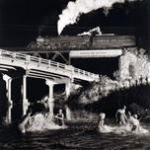
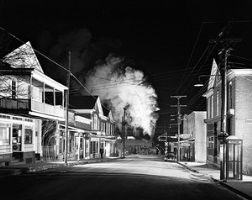
From Hawksbill Creek, Virginia –
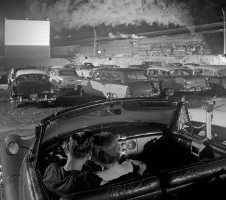
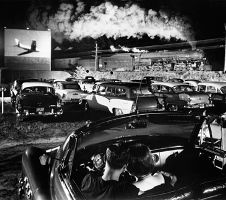
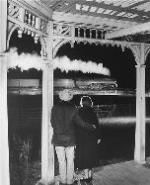
At a drive-in theater in Iaeger, West Virginia – Winston Link paid the couple to sit in Link’s convertible for $10 (in 1956). The first is the actual photo he took (for which the lighting drowned-out the screen’s image). The second was the actual released photo (after adding the plane from a negative he took).
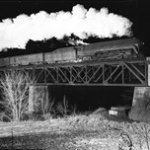
View of the last steam train (taken in Max Meadows, Virginia in 1958).
And to show a color photograph (after the conversion to diesel) at Shaffers Crossing in Roanoke, Virginia in 1960.
His work appeared in Trains magazine, and his sound recordings on albums (from 1957-1977) of steam railroad sounds. He retired at age 69 in 1983, and a touring exhibition of his work that same year made him more well-known to the general public.
In his early 80’s, his second marriage was now becoming toxic. Claiming that Link was now suffering dementia (and that she had power of attorney) his wife was eventually convicted of attempting to sell some of his works for her own gain. After her release six years later (and after Link’s death) she attempted to sell some of his works again – this time on eBay – and received a three-year sentence.
One final aspect of this marriage (in dispute) was whether Link was preyed upon by an adulterous wife (or, via her account) whether she was driven to it by his own vengeful behavior? The matter is explored in a documentary film from a few years ago. He himself had a cameo role in a film, appearing in October Sky in 1999 as … what else? … a railroad engineer.
O. Winston Link died in January, 2001 of a heart attack at the age of 86, driving himself to a hospital … to no avail, dying outside … where else? … a train station in South Salem, New York.
Many of his rail photos (as well as an accompanying audio CD of his sound recordings) are available in the book Life Along the Line, which also tells his life story. A more complete CD allows one to hear the sounds of steam trains rolling through small towns in the Virginias.
Link was involved in the planning of the museum that bears his name – which opened three years after his death at a former N&W station house in Roanoke, Virginia. Original prints can sell to collectors for thousands of dollars, while his images can be purchased (for much less) on postcards, calendars and the like.
For someone born in New York City, small-town America appealed to O. Winston Link – and a NY Times writer opined that he captured not only the end of a semi- prosperous Appalachia … but the end of an idealized small-town America. He once remarked that – unlike Ansel Adams, whose landscape photos would look the same way into the future – he had captured an era that would soon no longer be. Yet he never considered himself an artist, saying “I know what I want and I know how it’s going to get done and I know what it’s going to look like when I’m finished.”
Let’s close with two songs about railroading … one is an actual N&W corporate song (the railroad was merged into the Norfolk Southern Railway in 1982).
The other is a blues classic about a different rail line – the Louisville & Nashville Railroad (L&N) which eventually became part of CSX in 1982. The music to Riding on the L&N was composed by Lionel Hampton (with Dan Burley writing the lyrics). And below you can hear a 1966 version by bluesmen John Mayall and Paul Butterfield.
Football players at Northwestern University on Friday became the first U.S. student athletes to cast ballots in an election to decide whether to unionize.
The vote, which has the potential to upend college sports, was supervised by the U.S. National Labor Relations Board in a university building near the football field on the Evanston, Illinois, campus.
But the outcome will likely remain unknown for months. The NLRB is impounding the ballots cast by the players, who voted before and after workouts on a sunny, windy Friday morning, with small groups of four or five players wearing their Wildcats purple practice jerseys voting. http://www.reuters.com/article…
Okay, for non-college football fans Northwestern’s mascot is the Wildcat so now the title makes sense.
I have grown to think that college athletes should be paid; I just haven’t worked out all the details yet. Football and/or basketball is for many schools a huge money-maker that survives largely off the backs of the young men and women who play the sport.
Talking to reporters in the stadium parking lot on voting day, former Wildcats non-scholarship player Michael Odom said: “Everyone is getting paid except for the players – coaches get paid, the university gets paid, the guy who cuts the grass gets paid. But the guys out there sacrificing their bodies and actually making money for all these people are not getting paid.”
snip
Wildcats football recruits receive a “tender” that details the terms and conditions of their scholarship offer. Outside employment, social media use and behavior are all restricted. Northwestern exercises the type of control over players that employers do over employees, Ohr concluded.
40 TO 50 HOURS PER WEEK
Players spend 40 to 50 hours per week during the regular season practicing, playing and traveling to games, and receive scholarship assistance worth about $61,000 per year, Ohr noted.
“Not only is this more hours than many undisputed full-time employees work at their jobs, it is also many more hours than the players spend on their studies,” Ohr wrote.
The five-member NLRB board said on Thursday it would grant Northwestern’s request to review Ohr’s decision. As a result, the outcome of Friday’s election will not be announced until the board decides whether to affirm, modify or reject Ohr’s finding.
College is now more of a minor league farm system than an institution of higher learning. And so many are one-and-done, particularly in basketball, meaning they play one year for the exposure and then head off to the NBA or NFL although if I recall correctly there is an age limit that needs to be meant before a player can jump to the NFL that has to do with fitness.
This started years ago and was highlighted recently by an ESPN documentary on Michigan’s Fab Five who while being one of the greatest recruiting classes of all times were a huge marketing driver while reaping little of the benefits. College sports has become a business with venues being sponsored by corporations and coaches making seven figures. Meanwhile the players (legally) get nothing.
A close-to-home point was made to me as a huge Ohio State University Buckeyes fan when several OSU players were suspended and/or left the team a couple of years ago when the NCAA started an investigation into how the players had sold/bartered gifts they had received. A season was vacated and the school was barred from bowl games for a year. Look, if the players violated the rules they and the school should be punished. But what sticks in my craw is that the coach of the Buckeyes who withheld information from the NCAA, Jim Tressel, signed with the Colts the season after he resigned. If I recall correctly all he lost was the wins and losses from that year. Meanwhile at least one player had to sit out of the NFL for a year.
The current system is unfair and wishing that college meant learning for all students is so obviously not the case anymore. What the solution is I don’t know. Taking the college part out of the equation may be one option but that will happen right around George Clooney proposing to me.
So it will be interesting to see which way the vote goes and what, if any, affect this has on college sports going forward.
Recs on the weather jar comment are still welcome.
Friday Coffee Hour and check-in is an open thread and general social hour.
It’s traditional but not obligatory to give us a weather check where you are and let us know what’s new, interesting, challenging or even routine in your life lately. Nothing is particularly obligatory here except:
Fierces on the Weather Critter Comment are obligatory welcome.
The morning check-in is an open thread posted to give you a place to visit with the meeses. Feel free to chat about your weather, share a bit of your life, grump (if you must), rave (if you can). The diarist du jour sometimes posts and runs, other times sticks around for a bit, often returns throughout the day and always cares that meeses are happy … or at least contented.
For those new to the Moose, Kysen left a Moose Welcome Mat (Part Deux) so, please, wipe your feet before you walk in the front door start posting.
The important stuff to get you started:
– Comments do not Auto-refresh. Click the refresh/reload on your tab to see new ones. Only click Post once for comments. When a diary’s comment threads grow, the page takes longer to refresh and the comment may not display right away.
– To check for replies to your comments, click the “My Comments” link in the right-hand column (or go to “My Moose”). Comments will be listed and a link to Recent Replies will be shown. (Note: Tending comments builds community)
– Ratings: Fierce means Thumbs Up, Fail means Thumbs Down, Meh means one of three things: I am unFailing you but I can’t Fierce you, I am unFiercing after a mistaken Fierce, … or Meh. Just Meh. (p.s. Ratings don’t bestow mojo, online behaviour does).
– The Recommended list has a prominent place on the Front Page because it reflects the interests of the Moose. When people drive-by, we want them to see what we are talking about: news, politics, science, history, personal stories, culture. The list is based on number of recs and days on the list. Per Kysen: “The best way to control Rec List content is to ONLY rec diaries you WANT to see ON the list.”
– Finally, the posting rules for a new diary: “Be excellent to each other… or else”
(Some other commenting/posting/tending notes for newbies can be found in this past check-in and, of course, consult Meese Mehta for all your questions on meesely decorum.)
Happy Shakespeare’s birthday, everyone! The future playwright made his first appearance on the stage called “life” on 23 April 1564 at Stratford-on-Avon in Merrie Olde England and was baptized three days later. Little did John and Mary Shakespeare think that in his lifetime their infant son William was destined to become the greatest playwright and poet in the English–or indeed, any other–language. Join me in celebrating the 450th anniversary of his birth-it’ll be fun for the whole family! We have cake (even though it’s, ah, cybercake), links, poems, a video clip, and lots of speculation.
Those of us who have reveled in the delight of reading Shakespeare’s sonnets are familiar with the “Dark Lady” sequence (sonnets 127 through 154, according to the sonnet order of 1609, the year they were published). For centuries people have wondered about the identity of the Dark Lady, this woman who apparently drove the most respected playwright in London mad with passion:
Sonnet 147
My love is as a fever, longing still
For that which longer nurseth the disease,
Feeding on that which doth preserve the ill,
Th’uncertain sickly appetite to please.
My reason, the physician to my love,
Angry that his prescriptions are not kept,
Hath left me, and I, desperate, now approve
Desire is death, which physic did except.
Past cure I am, now reason is past care,
And frantic mad with evermore unrest;
My thoughts and my discourse as madmen’s are,
At random from the truth vainly expressed:
For I have sworn thee fair, and thought thee bright,
Who art as black as hell, as dark as night.
The three women thought most likely to have been Shakespeare’s dark mistress are Lucy Morgan, also known as “Black Luce,” a well-known prostitute in Clerkenwell; the poet Emilia Lanier, the Earl of Hunsdon’s mistress and later the wife of Alfonso Lanier; and Aline Florio, the wife of linguist and translator John Florio.
Possibly the most anguished, bitter sonnet Shakespeare ever published was this one:
Th’ expense of spirit in a waste of shame
Is lust in action; and till action, lust
Is perjured, murd’rous, bloody, full of blame,
Savage, extreme, rude, cruel, not to trust,
Enjoyed no sooner but despisèd straight,
Past reason hunted; and, no sooner had
Past reason hated as a swallowed bait
On purpose laid to make the taker mad;
Mad in pursuit and in possession so,
Had, having, and in quest to have, extreme;
A bliss in proof and proved, a very woe;
Before, a joy proposed; behind, a dream.
All this the world well knows; yet none knows well
To shun the heaven that leads men to this hell.
Recently my husband and I watched “A Waste of Shame,” a film starring Rupert Graves, which explores the topic of the Dark Lady. In this film she’s thought to be Lucy Morgan, a dark-skinned woman of unusual appearance-not pretty, exactly, but possessing that indefinable quality known as “presence.” We’re meant to think of her as a dark-eyed doxy, but what I saw was a woman doing her best to survive in a harsh world while earning enough to sustain her son in faraway France. There were few ways for women to earn their keep in those misogynistic times, so if she could make money from her looks and her skill at lovemaking, who are we to judge?
The film took all sorts of liberties, especially when Shakespeare contracted the French pox from his French mistress and had to subject himself to remedies that were really hair-raising. The end of the film showed Shakespeare delivering his sonnets to the publisher in 1609 and then going home to Stratford-on-Avon. (In real life, Shakespeare went home for good in 1613.) I must say, never have I thought, “It’s only a movie” with such gratitude as the film drew to a close.
Not much is known about Emilia Lanier (1569-1645). Five years younger than Shakespeare, she apparently was the fourth woman in English history to publish a book of poetry. Perhaps Lanier was Shakespeare’s Dark Lady and perhaps she wasn’t. There’s simply no proof.
The third candidate for the role of Shakespeare’s Dark Lady is Aline Florio, the wife of linguist and translator John Florio. While her husband translated the work of Montaigne, Aline fooled around with his friends. She was supposed to have been “narcissistic, self-centered, and licentious,” which pretty much describes half the human race even now. The poor thing isn’t here to defend herself, so let us leave it at that.
In closing, one cannot do better than to quote from Howard Jacobson’s article in The Telegraph:
It’s possible that had there been no Dark Lady, had Shakespeare never wandered into Clerkenwell or stolen reechy kisses from the wife of a scholar too busy translating Montaigne to notice, these sonnets about loathing what you love, about believing what you know to be untrue, about the falsity at the very heart of sexual desire, would not have spoken to us with such disquieting force. But there’s always another Dark Lady. Isn’t that what these poems proclaim: that erotic love is full of pain and contradiction, an eternal search for an anguish one cannot bear and cannot bear to be without? We diminish them by making them the story of an actual affair. We diminish thought, we diminish imagination, and we diminish art.
Recs on the weather jar comment are still welcome.
The common Moose, Alces alces, unlike other members of the deer family, is a solitary animal that doesn’t form herds. Not so its rarer but nearest relative, Alces purplius, the Motley Moose. Though sometimes solitary, the Motley Moose herds in ever shifting groups at the local watering hole to exchange news and just pass the time.
The morning check-in is an open thread and general social hour.
It’s traditional but not obligatory to give us a weather check where you are and let us know what’s new, interesting, challenging or even routine in your life lately. Nothing is particularly obligatory here except:
I’m doing the Hill Country Ride for AIDS on Saturday. This Saturday. I’m nowhere near my fundraising goal, but I’m not moving the goalposts until after the opening dinner the night before the ride. And we’re just not gonna talk about my fitness level. (even though I’m doing the shortest route, prayers would probably be appropriate this Saturday morning) This diary is to tell you about the people helped by your donations. If you want to bypass all the heartwarming stuff, you can just donate here at my Hill Country Ride Page. But if you want to read some great stories about people getting the help they need, come below the squiggly thing. Be warned, since the Ride is only at 72% of their goal, and I’m at 20% of mine, I’m going to pull on your heartstrings all I can. my Hill Country Ride Page
Here’s the story of a woman helped by The Wright House: “My name is Annette Y. K. and I recently began receiving services from The Wright House Wellness Center. In a nutshell THE WRIGHT HOUSE lS CHANGING MY LIFE! I have drudged through 15 long years of medical negativity, mental anguish, and no help for my daughter’s stress level and emotions. The Wright House has addressed all of these issues and many more without once making me feel uncomfortable, outof-place, judged or a burden. The Wright House helped me see I was not alone. And my beautiful l5 yr. old daughter, Jessica, is able to release years of pent up anger, hurt, rejection and pain for the first time in her life. To see her smile again, to hear her sing again, and to see the spark coming back in her eyes; these are things I was afraid I would never see again in Jessica. The Wright House is a safe place for her to talk with people who understand. That alone takes an unbelievable amount of weight off my shoulders and my heart. Once I opened the door at The Wright House I felt like the most important person in the world. A Peace came over me that I had not felt in years. I was greeted with smiles and handshakes by everyone I encountered. The staff was so kind and gentle. I was touched by their unconditional care. And when leaving I was given a hug or two. That’s very rare in my life.”
And here’s the story of someone who is getting help from the Waterloo Counseling Center: “It took me almost a year after I found out I have HIV to even tell anyone. I was only 24 at the time, and I thought my life was over. I wanted to talk to someone, but I just couldn’t deal with it. I wouldn’t even see a doctor because I thought that getting on meds would mean I was dying. I lost a lot of sleep, until I called Waterloo Counseling Center. At first, I just couldn’t talk about my HIV, even to my counselor. But he waited me out. He sure was patient! I finally opened up, and that’s when everything changed. My counselor helped me focus on “living with HIV” instead of “dying of HIV.” I felt like a burden had been lifted. I even worked up the courage to find a doctor and get on medication for my HIV. I was really surprised to notice that for the first time in a long time, I felt optimistic about taking care of myself. I know now that I have a future, and I’d better start planning for it! So I enrolled in college and am looking forward to what life brings. I can’t thank my Waterloo counselor enough.”
And here’s the story of a man who takes care of his six grandchildren with help from Community Action: “I have been a client of Community Action’s Rural AIDS Service Program for years. The compassion and sheer dedication of this agency continually amazes me. My spouse and I have had long term custody of six of our grandchildren. Without Community Action I know I would not still be healthy today and providing a safe, happy home for them. I believe this assistance is why my blended family has not only survived, but is now thriving. From a listening ear and assistance locating community resources to help with food, clothing, and gas for medical appointments, the existence of this agency has literally transformed my life. There aren’t many things in life you can count on so being able to count on this agency has been and remains a huge blessing in my life. I don’t know what I would have done, or where my family would be today without it.”
and a story from The Care Communities: “Hello my name is Jack Foster. I was diagnosed with AIDS in June of 2010, which I got from a girlfriend. They gave me one year to live and sent me to Doug’s House to die. They didn’t know the care I would get, and here I am almost a year later, now living in my very own place! I am able to get around, but I need help from the volunteers of The Care Communities. They help me with groceries, getting to the doctor, and just someone to talk to. They helped me move from various apartments and find furniture for my current apartment. We also go out for coffee and they have taken me out to the circus and crop mazes. The volunteers I have from The Care Communities are great, I don’t know what I would do without them.”
and a story from Project Transitions that made me cry: “Jeff was a resident at Doug’s House for four separate occasions over a seven-year period. During that time, Jeff established himself as an integral part of the story of Doug’s House. Each time he came to Doug’s House he had experienced a significant decline, resulting in him no longer being able to live independently. At Doug’s House, Jeff was able to receive the critical services he needed, such as a safe place to stay and access to meals and medications. When asked how he felt about coming back to Doug’s House most recently, Jeff stated, “I feel like I’m coming home.” Jeff died peacefully at Doug’s House this past weekend. Jeff’s mom stated about the staff at Doug’s House, “They are the most loving, caring, professional group of people. I don’t know how we could have done it without them.” Jeff was always so grateful for the support he received at Doug’s House. If he were alive today, he would want to say “Thank You” to all of the supporters of the Hill Country Ride for AIDS. Your support helps to continue the great work of Project Transitions.”
Here’s a story of a woman being helped by AIDS Services of Austin: “Nine years ago, I got a flu that I couldn’t shake. Months went by and I wasn’t getting any better. I had a persistent fever, cough, and aching body. Visit after visit to the doctor, I was finally tested for HIV. When the doctor spoke with me about the results, I remember he started by telling me everything was fine, that my T cell count was up, that my viral load was way down, and that for the most part I was healthy, except….I was HIV+. I immediately felt a shroud of fear, abandonment, and disbelief come over me. The doctor left my exam room for just a moment and immediately I began to think about the end of my life. I felt so alone. There is so much stigma associated with being HIV+; so much to think about when dating or creating friendships. I’m cautious about whom I reveal my status too, but I reveal it often to help people see that mine too, is the face of someone with HIV. I use it as an opportunity to educate folks, to help remove some of the stigma. I joined the Women Rising Project at AIDS Services of Austin so that I could learn from the experiences that other women with HIV and AIDS face. I joined the Women Rising Project because I needed a fellowship of people who empower, encourage, and educate me. I needed a group of people to build me up and support me in reaching my goals. When I first found out that I was positive, I felt so demoralized. But with my faith and with the Women Rising Project, I have transformed. Now I want to be a motivational speaker, and help young women and girls avoid the challenges I have faced in my life. I am so overwhelmingly willing to talk about my story, to absorb as much information as I can to maintain my health, and to reach out to others to encourage and empower them. I think my story is a story of success.
and here’s something about Allgo, a statewide organization for queer people of color: “Allgo’s story is about the numerous clients who come to allgo for information and referrals for HIV testing. This is a vital resource to their health and wellness. They have expressed that many places will only allow them to take a couple of condoms at a time, and that because they are able to get the amount of supplies they need from Allgo, this contributes to their ability to take care of themselves. They have also expressed how they feel very comfortable coming to Allgo where they don’t feel scrutinized, questioned, or interrogated for trying to protect themselves. Your commitment and dedication to the Hill Country Ride for AIDS helps us do the work we need to do to provide this safe space for some of the most marginalized people living in Austin who are at high risk.”
This is just some of the direct help to people you give when you give to the Hill Country Ride for AIDS. Please donate at my Hill Country Ride Page
And just so you know this isn’t an impostor, here’s the obligatory U2 song, I’m using my race day song, the song that convinces me I can do impossible things. So, here’s City of Blinding Lights, can we pull off a miracle & get some donations & help some people? Bono talks at the beginning of this about remembering why he wanted to be in a band — I’m remembering why I do this ride
It has been disheartening lately to read about the penny-wise pound-foolish despoiling of our earth for short term profits and jobs that will disappear in a few years. West Virginia, Pennsylvania, Wisconsin … the list goes on. Maybe we need an Earth Day wake-up call to remind us of what is important.
Back when Wisconsin was known for progressive politics and good government, Senator Gaylord Nelson (D-WI) spoke of the Santa Barbara oil spill that had occurred in 1969 and awakened people from their complacency about our environment. He called for a teach-in and that eventually resulted in the establishment of Earth Day in April 1970.
“a nationwide demonstration of concern for the environment so large that it would shake the political establishment out of its lethargy and, finally, force this issue permanently onto the national political agenda.”
We are still struggling to make the environment, and climate change, important enough to be part of the national political agenda … not just on Earth Day but every day.
Nelson’s decision to leave Earth Day to the grassroots proved genius. Exceeding their wildest expectations, Nelson and his staff estimated 20 million Americans-from 10,000 elementary and high schools, 2,000 colleges, and over 1,000 communities-took action on April 22, 1970. Though students lent the day a unique spirit, it did not draw out only the young. Labor union members, housewives, farmers, scientists, and politicians of all stripes-from Barry Goldwater to Edward Kennedy-made up the mosaic of faces in Earth Day crowds.
Throughout his life Nelson remained modest about his own contribution but was extremely proud of the nation’s response:
“Earth Day worked because of the spontaneous response at the grassroots level. We had neither the time not the resources to organize the 20 million demonstrators who participated from thousands of schools and local communities. That was the remarkable thing about Earth Day. It organized itself.”
Today is Earth Day! Over one billion people in 192 countries are participating from London to Sao Paolo, Seoul to Babylon City, New Delhi to New York, Rome to Cairo; people everywhere are taking action in their communities and helping depict The Face of Climate Change.
How can you get involved? Attend an Earth Day event in your community, start doing something to lower your carbon footprint, and take a photo of yourself being part of the solution and upload it to The Face of Climate Change Wall.
My son is 19 and has been trying to get a job for three years…but nobody will hire him. I don’t want to believe it’s because he’s black, but…
When my son hit 16 in March of 2011, I told him: “Welcome to the work force!” I took him around to various fast food joints and grocery stores where he put in applications for basically any and every entry level job you can name from dishwasher to bus boy to bagger to stocker to janitor. We both thought it would be a matter of time before he got an interview and then a job. However, here it is over three years later and in spite of our continued efforts to find a job for him, he still hasn’t been hired.
My son is a great young man. He graduated from high school last year, made good grades and never got into trouble. Right now, he’s attending the local community college, where he continues to do well. To put it bluntly, he’s a model citizen.
One thing that really exasperates me is that one of his best friends of the Caucasion persuasion who I know well because he lives down the street from us and is roughly the same age, has already been hired at three different nearby places. All of which are places where my son also applied, including the place with the golden arches, which generally hires almost anyone white that walks in without a prison record. That young man from down the street is not nearly as intelligent, responsible, well-mannered, well-groomed or well-spoken as my son. Not even close. Yet, he gets hired repeatedly? And by the way, the reason he’s had at least three jobs is because he keeps getting fired.
We all are aware of the school-to-prison-pipeline, for profit-prisons, the targeting of young males of color in police programs like Stop and Frisk…and the death statistics for far too many of our youth cut down by gun violence and police. We also know that this nation has a long history of stereotyping black males into the roles of animals, and ‘wilding’ rapists, and thugs.
Wherever there is a narrative, there are also efforts to build counter narratives. These young brothers have a video they would like you to see.
Counter-Narrative on Black Male Students: At Central High School’s Black History Month Celebration, the Central and Centennial High School African-American Clubs released a joint video countering the negative images of young African-American males in the media. The students affirmed the following in a video highlighting the successes of young black males within the District:
• We are not gangsters and thugs.
• We are employees and volunteers.
• We are scholars.
• We are athletes.
“The negative stories told daily in the media and in our culture about our young African-American men tend to ignore their successes and don’t tell the full story about how young Black men are becoming leaders within our community schools,” said Central School Social Worker and African-American Club Sponsors Tiffany Gholson and Barbara Cook, who worked with the students on this effort. “In this video, our students reclaim the narrative of who they are and inspire other students to follow in their footsteps.” In our assembly, we addressed the State of the Youth and highlighted what Black students have overcome from a historical perspective. The assembly also highlighted how overcoming those obstacles has helped make America stronger and urged students of all backgrounds to carry the torch for future generations
Clearly, no videos can change the systemic racial inequity and economic inequality faced by today’s black youth. The data is grim.
Youth unemployment is even worse than the unemployment rate suggests
The high unemployment rate for young Americans is a bad sign, but it doesn’t even begin to tell the whole story of just how grim employment prospects are for today’s young adults. Looking just at the overall unemployment rate obscures the extremely high rates of unemployment among communities of color, ignores workers who have given up on finding a job, and fails to take into account the many workers who are underemployed relative to their skills and education levels.
Unemployment is a major problem for young Americans in general, but it’s an even bigger problem for young people of color. While the overall unemployment rate for teenagers is 25.1 percent, the unemployment rate for black teens is 43.1 percent. And fully half of black males ages 16-19 are looking for work but unable to find a job.
In Chicago 92% of black male teens are unemployed. That is not a typo.
There are multiple factors that contribute to this staggering percentage.
There are solutions too. All of which are going to require cash and programs. From my perspective we need a Marshall Plan for right here at home, which is something civil rights groups across the nation have called for for decades.
With Republicans controlling the House, there is zero chance of passing legislation like the Pathways Back to Work Act “a federal measure that would create a $5 billion fund to help pay for summer and year-round job opportunities for low-income youth, work-based training for both adults and young people and subsidized employment programs for jobless and low-income adults.”
Though President Obama has issued a memorandum “Creating and Expanding Ladders of Opportunity for Boys and Young Men of Color” and the My Brother’s Keeper Task Force (which of course was immediately decried by wing-nuts, who have already labelled efforts to raise the minimum wage as “The “Black Teenage Unemployment Act”), the only long term solution will have to be legislative.
Yes, we have community organizations across the nation who are trying to address these problems at the local level, and they merit our support.
But as long as we have a right wing determined to roll back the gains we’ve made in the past, from the Roberts Court, to the Congress, to state legislatures, we are only able to apply band-aids.